Endgame continues to be one of the hottest topics in the pensions industry, with the conversation expanding beyond traditional buy-outs to a range of alternative solutions, such as the establishment of a public consolidator and a heightened focus on schemes running on indefinitely.
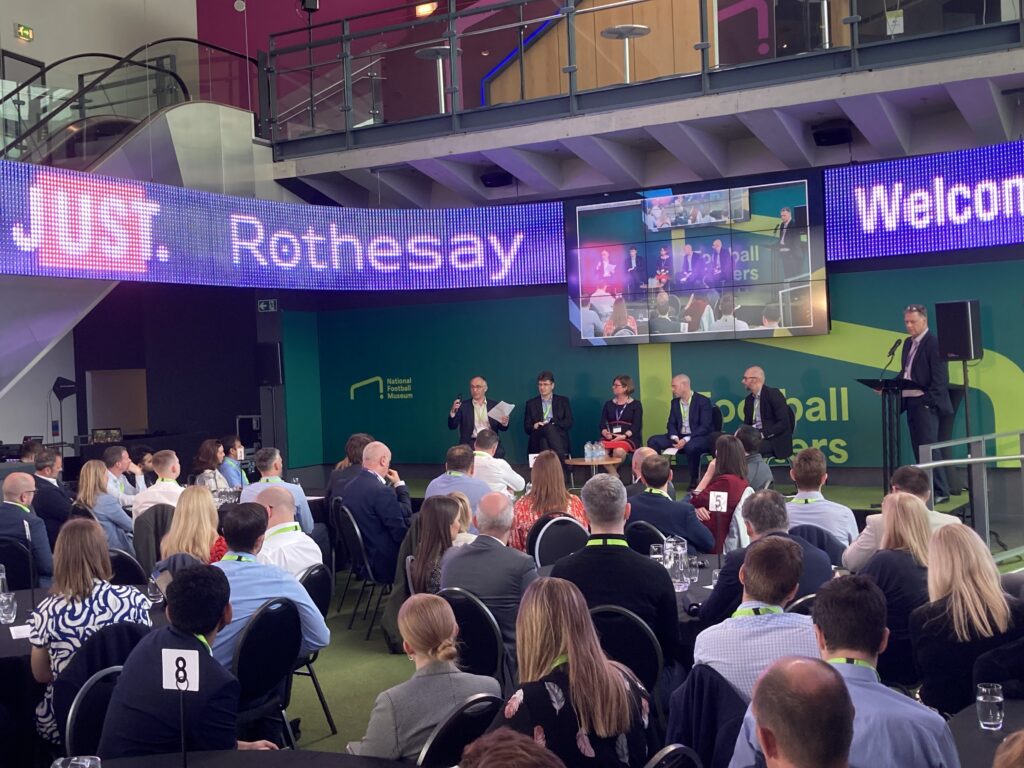
We recently hosted our Endgame Solutions Conference, bringing together over 250 professionals from the world of pensions. During the day, I chaired a fascinating session viewing alternatives through different lenses. I was joined by a diverse panel of experts, including David Taylor (Executive Board Member and General Counsel at the Pension Protection Fund) (PPF)), Jonathan Griffith (Pensions Partner and Head of Engagement and Innovation at LCP), Sammy Cooper-Smith (Head of Business Development at Rothesay), Simon Daniel (Partner at Eversheds) and Naomi L’Estrange.
Each brought their unique perspectives and we had a healthy debate about the current and future landscape of pension endgames.
Contrasting views on the public consolidator
We first tackled the proposed public sector consolidator. Expected to be in place by 2026 and run by the PPF, this was a plan from the former Conservative government. David Taylor from the PPF felt a consolidator would provide valuable alternative for some schemes and trustees, distinct from commercial options.
David explained the PPF is designing a detailed plan based on industry feedback to give some shape to the proposition. Although the market is relatively small, the PPF estimates that for around 2,000 schemes with assets worth £130 billion, a public consolidator could be a significant benefit by operating separately from the main PPF fund, maximising efficiencies and investing for long-term growth (including productive finance).
Required to accept qualifying transfers, the proposed solution would help pension schemes unattractive to commercial providers (such as underfunded schemes), whilst providing an equivalent level of security for members as commercial consolidators. The plan to provide full benefits on a range of standardised benefit structures could be a welcome innovation in the industry – insurers may like it but would trustees?
However, some panellists questioned the rationale for a new consolidator. They had not yet come across a scheme unable to get a commercial quote, although acknowledged affordability was a different matter. Concern was raised it could undercut the insurance market by 10-20% – one of the stated objectives for a public consolidator is to not disrupt the existing market – eligibility and price will determine whether this is an issue.
Keep on running
Defined benefit (DB) schemes are currently in a robust position, prompting a wave of innovation within the market.
Jonathan Griffith promoted the merits of running schemes on. Whilst the decisions and discussions around run on are not new, what is new are the sheer number of schemes, significant surplus sizes and new products on the market that are driving interest in managed running-on strategies.
Pension scheme surplus is emotive. It attracts heightened media interest – echoed by scheme members, sponsors and government. Legally it has always been difficult to decide who owns it.
The long-term objective is usually to pay benefits that are due. But given the world we’re in with surpluses, with MPs calling out pension schemes that are just paying what’s due, shouldn’t we aim for better? But what is good enough? It will be different for every scheme and scenario. There are lots of options on how to use surplus – discretionary increases, remove caps, provide defined contribution (DC) benefits, use investments for ESG/sustainable growth, provide cash to employer for investment to secure jobs etc.
Run on decisions are best managed by those currently running the scheme, ie the trustees, who can consider all views, retain control, and react to evolving circumstances. Sammy Cooper-Smith highlighted the importance of trustees understanding who in the scheme is taking the risk and managing the members effectively if things go wrong, as running on does not come without risks. A 10% uplift helps pensioners now but everything could go wrong before deferred members get to benefit from it. Such risks could now be better managed thanks to new
The suggested super levy – where, if paid, members get 100% of benefits – is under consultation. There is interest in the super levy from large corporates – would this free up pension schemes to invest more and run on for a longer period? That may require recalibration of trustee fiduciary duty (currently trustees can’t consider the existence of the PPF).
The devil is in the detail
As the industry continues to innovate and explore alternative solutions, it is crucial for debate and challenge to continue across the market. The devil is often in the detail and a comprehensive understanding – and robust evaluation – of the alternatives available will help ensure they are well-positioned in the market and that target audiences are understood.
This level of scrutiny is essential for making informed decisions that benefit all parties. Overall, prospects for members look good with far fewer schemes looking unable to pay full benefits and more options for trustees and sponsors to think about as they look for the right solution for their scheme.
If you would like to discuss alternative endgame solutions, please contact David Griffiths or one of Vidett’s Endgame Solutions team.